
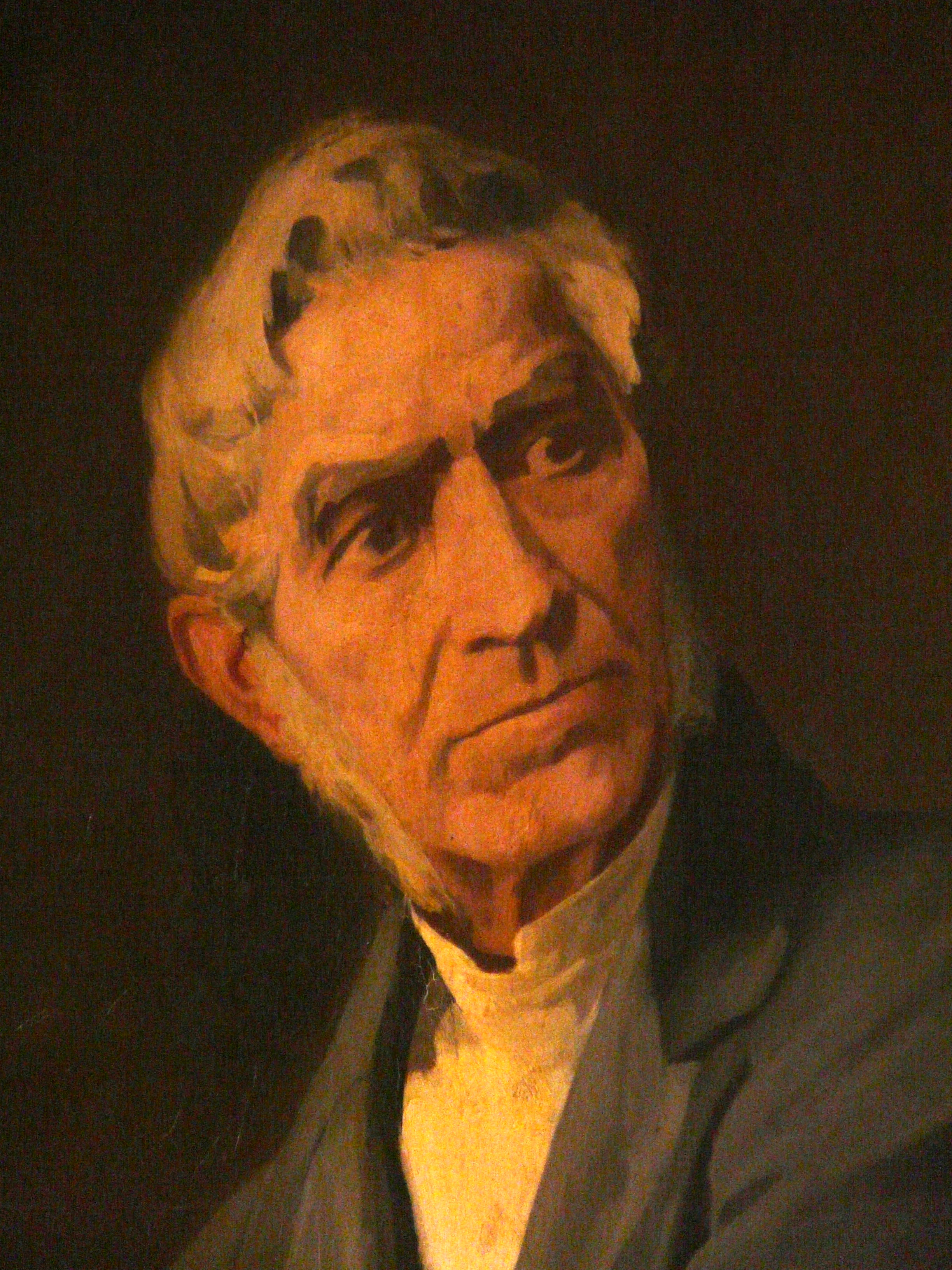
Adolphe Quetelet was born in Ghent on February 22, 1796. He studied humanities at the Ghent Lyceum and began studying science at the newly founded University of Ghent in 1817. On July 24, 1819, he received his doctorate in science from Ghent University. There, he also met the then Minister of Education, A.R. Falck (born 1776 - died 1843), who was impressed by this young doctor and appointed him a mathematics teacher at the Athenaeum of Brussels. That same year, Quetelet moved to Brussels, where he was appointed a member of the Academy.
Quetelet's idea to establish a large observatory in Belgium took shape in 1823. With the support of Minister Falck, he was allowed to go to Paris at the end of 1823. This was not only to familiarize himself with astronomical observations but also to gather all the necessary information for the construction of an observatory. His report and proposal received the full support of the Academy and were submitted to King William I. This would ultimately lead to the Decree establishing the Observatory, signed by the king on June 8, 1826, and the start of construction in 1827.
Meanwhile, on September 20, 1824, Quetelet married Cécile-Virginie Curtet (born 1801 - died 1858), the niece of the scientist, chemist, and pharmacist Jean-Baptiste Van Mons (born 1765 - died 1842). Their son, Ernest, was born on August 7, 1825. On November 26, 1826, they had a daughter, Marie-Isaure.
In addition to his work on the preparation and construction of the Observatory, Quetelet co-founded a science program at the Museum of Sciences and Letters in 1826. In 1827, he taught courses in astronomy, history of science, and anatomy. He only taught there for one year, however, as he resigned in 1828 to become director of the Observatory. Between 1828 and 1830, he traveled extensively, visiting nearly all the major observatories in Europe, providing him with sufficient knowledge to subsequently devote himself to the further development of the Observatory. Even after the founding of Belgium in 1830, he was confirmed as director by Leopold I.
Quetelet became the permanent secretary of the Academy in 1834. He organized public sessions for the first time and actively participated in the 1845 reforms that divided the Academy into three classes (Sciences, Letters, and Fine Arts). He was appointed professor of astronomy and geodesy at the Royal Military Academy in 1836. In 1841, he became chairman of the Central Commission for Statistics, which he described as a crowning achievement of his scientific career. At the request of Leopold I, he taught his nephews, Princes Ernst and Albert of Saxe-Coburg. The latter married Queen Victoria of England, also a niece of Leopold, in 1840. Quetelet's most important contribution to astronomy, besides establishing and directing an observatory and making numerous meteorological and astronomical observations, was his work on meteors ("shooting stars"). Assisted by his collaborators, he collected numerous meteor observations, which he statistically analyzed. He was probably the first to predict the annual return of the Perseids meteor shower.
But Quetelet's scientific interests were primarily in statistics and demography. He developed the concept of the "average person" and is known to the general public for his "Body Mass Index" (BMI), also known as the Quetelet index. Quetelet was among the first to apply statistical methods to the social sciences. He recognized the complexity of social phenomena and the need for numerous variables to understand the processes underlying them through statistical rules. His works on political, philosophical, and methodological issues also earned him a pioneering role in sociology. He also enjoyed considerable international recognition as a statistician, corresponding with prominent figures such as Ampère, Fourier, Gauss, Goethe, Laplace, and Faraday.
Quetelet suffered a stroke in mid-July 1855. His son, Ernest Adolphe François Quetelet (born 1825 - died 1878), took over his father's administrative duties at the Observatory from that point on.
Adolphe Quetelet died in Brussels on February 17, 1874. He was buried in the family grave at the Brussels Leopoldswijk cemetery in Saint-Josse-ten-Noode. This gravestone was moved in 1883 to the Brussels city cemetery in Evere.